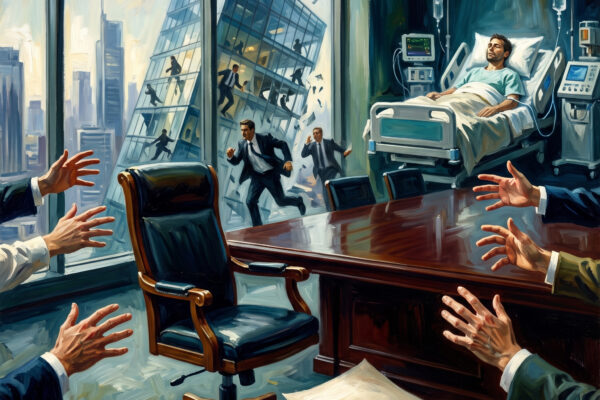

A 39-year-old, founding partner in a startup company, flew for a weekend to a ski resort and one unfortunate slip sent him to intensive care and the company to a rapid crash course, as his absence prevented it from paying employees and suppliers or performing other material and urgent tasks. A lasting power of attorney could have prevented the company's collapse, but even a lasting power of attorney that was not duly drafted, or incompatibility of the company's articles of association for its use, can lead to a collapse.
If in the past a loss of capacity was perceived as a private/family event handled behind closed doors, in the modern era such an event may constitute a corporate event for all intents and purposes. Sometimes, the issue that arises is not the question of the existence of the lasting power of attorney (a powerful tool introduced into use in Israel in 2016), but the lack of corporate synchronization: a gap between the individual's wishes and the company's articles of association.
While in the event of death there is a regulated inheritance mechanism (or automatic expiration of office) that allows for a relatively quick "passing of the baton" in a corporation in which the deceased was a shareholder or held a senior position, in a situation of loss of capacity without prior planning, chaos sometimes ensues, because in the absence of a mechanism fixed in law, there is no decision-making authority and the business may fall into a standstill. A lasting power of attorney is a tool designed to ensure control and advance planning in situations of lack of capacity, while transitioning from state decisions (guardianship) to human autonomy. In the corporate world, the lasting power of attorney can help prevent the collapse of the business the moment its owner loses capacity (sometimes for a limited period). Beyond bureaucracy, there is a real legal tension: while the attorney-in-fact is obligated to act in accordance with the appointor's instructions, the office holder (director or CEO) is obligated by law to act in the best interests of the company. Thus, insofar as the lasting power of attorney appoints a person as an office holder in the company instead of the appointor (who temporarily, or permanently, lacks capacity), incorrect drafting of the documents may cause conflicts of interest.
Under the Israeli Companies Law, the duties applying to the office holder are personal duties towards the corporation and cannot be transferred or bypassed through an external power of attorney alone. The law establishes substantive capacity limitations for directors, alongside a duty of immediate notification upon loss of capacity, and if the loss of capacity prevents a person from reporting, there is no simple mechanism to remove the director. In a Supreme Court verdict from 2016, it was held that a director who loses capacity is required to inform the company of this (and under law his tenure will expire on the date the notice is given) and as long as he did not inform, he is liable to the company, where he might not be liable if it is a situation of inability "to understand that he is no longer capable of properly fulfilling his role, such as when a director becomes senile or loses his sanity". However, the exemption from liability does not assist to prevent the damage, of course. When the lack of capacity is of a senior office holder (for example, a CEO), and that person is also a material shareholder and perhaps also a director (as often happens in family corporations or startups), this may, in the absence of advance preparation, cause a standstill that only an appeal to the Court will be able to allow an exit from, and even this in a proceeding that may not only cost precious time and great costs, but also make the Court the one who decides, instead of the person.
Thus, it is advisable to prepare in advance, especially in a family company or in a company where there is a controlling shareholder who is also an office holder, and to build an orderly intergenerational transition system that will include not only a lasting power of attorney and a will, but also the necessary changes to the company's articles of association and perhaps to the shareholders' agreement and any other contractual infrastructure, with legal alignment between the documents, in order to ensure the functional continuity of the corporation. It is important that the documents are not prepared by an inexperienced lawyer who has only undergone basic training in lasting powers of attorney, but by a law firm with expertise in corporate law along with an understanding of such tools.